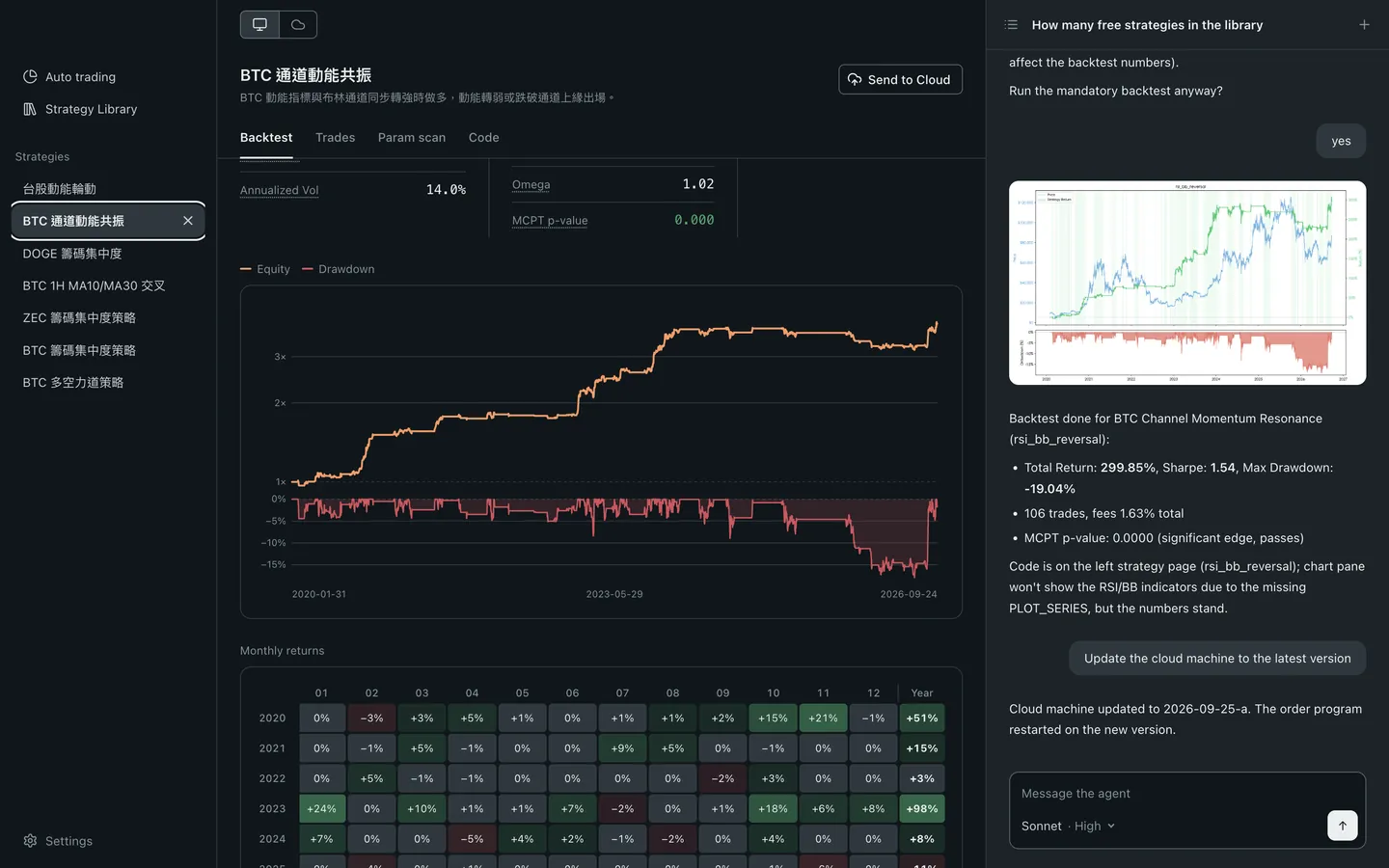
Blave Agent Enters BTC Only When Momentum and the Bollinger Band Agree — Sharpe 1.62, MDD 20.96%

One signal alone will lie to you. Two independent signals agreeing is what makes it worth trusting. Most single-indicator strategies share the same flaw: any one signal, on its own, gets faked out by noise — RSI throws false breakouts in a chop zone, and price can whipsaw through a Bollinger Band in a tight range just as easily. This strategy forces two independent signals to agree before it acts: on 5-minute BTC bars, it goes long only when RSI clears the momentum midpoint AND price closes back above the lower Bollinger Band on the same bar. The moment momentum fades and price breaks back below the upper band, it exits to flat immediately — no holding through a stale signal. Long-only, no leverage, and position size scales dynamically with volatility: smaller when the market is chaotic, larger when it's calm, never a fixed full size held blindly through a storm. Where the edge comes from RSI and the Bollinger Band measure different things — momentum versus price's position in its recent range. Requiring both to agree independently trades entry frequency for entry quality: over 6.5 years (2020–present) it made about 42 round trips, averaging a ~25-day hold, in the market roughly 45% of the time — the rest spent waiting rather than guessing. Why it works — and the cost The cost first: this stability is bought with dynamic volatility targeting, not free. The same entry/exit logic run at fixed full size backtests to +2179.86% total return (Sharpe 1.41, max drawdown −47.22%); with volatility targeting applied, total return drops to +323.27%, but Sharpe rises to 1.62 and drawdown tightens to −20.96%. It trades away raw full-size upside for a curve that holds up far better in a drawdown. More honesty: 2 of the 7 calendar years were negative — 2025 (−10.57%) and 2026 year-to-date (−3.82%). It doesn't win every year. But BTC buy-and-hold returned −7.37% and −25.79% over those same two periods — the strategy beat the benchmark by a wide margin in both down years, it just didn't hold an absolute positive return. We tried the short side too: BTC, ETH, DOGE, BNB, and SOL all got scanned for a working short-side parameter set, and none of the five had a real edge — long-only is the shipped design because it was tested and the alternative didn't hold up, not because shorting was never considered. The backtest passed a 2,000-run Monte Carlo permutation test (p≈0.01) — fewer than 1% of 2,000 random shuffles did better. Backtest performance (2020–2026, ~6.5 yrs, 5-min bars) MetricValuePeriod2020–2026 (~6.5 yrs, 5-min bars)Total return+323.27% (BTC buy-and-hold same period: +588.88%)Annualized24.61%Sharpe1.62Max drawdown−20.96%Round trips~42 over 6.5 yrs Backtest results, not a guarantee of future performance. The strategy is free. The hard part is keeping it running. The logic is above. But watching RSI and the Bollinger Band around the clock, timing entries and exits, and routing orders without ever going offline — that's the infrastructure traditional quant burns weeks on. Blave Agent runs that chain for you. You're not paying for the strategy; you're paying to keep it live. Start in 3 steps ① Install Blave Agent② Add credit (from 300 TWD) to start your Blave Agent③ Tell it "load the official BTC Momentum-Channel Confluence strategy" → one-click deploy, running 24/7 You don't build it yourself — the official strategy is free, one line loads it. From 300 TWD to start; then you pay only for runtime: server from 1.6 TWD/hr, platform 3 TWD/hr, plus AI usage. Install Blave Agent and put this strategy to work today →
このような戦略は、あなたの Blave Agent で運用できます。
実際のバックテスト付きの既製戦略を見る →