How to turn "I think this works" into a number you can actually check — and where most people get stuck.
Last updated 2026-10
Key Takeaways
Quant trading means writing your trading logic as explicit rules and validating those rules on historical data, instead of judging each trade in the moment.
A trading signal is not a strategy: a signal says when something is happening; a strategy adds position size, risk limits and execution rules, and is the thing you can actually run.
The point of going quantitative is not better prediction — it is that a written rule can be tested, and a feeling cannot.
Costs decide more than people expect: in one real Blave Agent backtest (an old snapshot at 0.05% per side), fees cumulatively ate about 22% of equity over four years.
You do not need a strategy idea to start — every official Blave Agent strategy is free and ships with its real backtest.
You have an idea. When this pattern shows up you buy, and you get out 3% lower. You scroll back through the chart and it looks right. Then you put real money behind it, and you have no way of knowing whether you were right or whether you just picked the handful of candles that agreed with you. Quant trading exists to close exactly that gap.
What is quant trading?
Quant trading is using data and statistics to define your entry and exit rules in advance, then letting those rules decide the trades instead of judging each one in the moment. The rules can be simple (a moving-average crossover, an RSI threshold) or complicated (multi-factor models, machine learning). Complexity is not the point.
The point is that a written rule produces the same answer every time you run it. That is what makes it checkable. You can take those rules, run them over four years of historical data, and get concrete numbers: what the return was, how deep the worst drawdown got, how much of it the fees ate.
Going quantitative does not make you better at predicting the market.
It makes your ideas falsifiable. A rule can be wrong in a way you can measure; a feeling can only be wrong in a way you rationalise afterwards. That is the whole trade you are making.
Trading signal, strategy, portfolio — what's the difference?
A trading signal is the output of a condition: it only says which side you should be on right now, not how much to buy or when to cut. These three words get used interchangeably, and mixing them up is the single most common reason a promising idea never becomes something you can run.
Term
What it is
What it does not include
Signal
The output of one condition — typically +1 (long), 0 (flat), −1 (short). It answers is something happening right now?
How much to buy, when to cut, what to do if the order fails
Strategy
A signal plus position sizing, risk limits and execution rules. This is the thing that can actually be deployed and held accountable.
How it interacts with your other positions
Portfolio
Several strategies or symbols combined with a weight allocation across them.
—
Most people who say "I have a strategy" have a signal. That is not a criticism — a signal is the hard, creative part. But a signal on its own cannot be backtested honestly, because the result depends entirely on the sizing and risk rules you have not written down yet.
In Blave Agent this distinction is structural: a signal-based single-symbol strategy is Type A and requires a backtest, a multi-symbol portfolio with a weight vector is Type C and also requires a backtest, and everything else is Type B, which does not.
How does a trading signal become a filled order?
A trading signal does not place an order. It is only a number: it first has to become how much of the symbol you should be holding right now, and then be netted against the position you already have — the difference is the order that actually goes out. Going from backtest to live, these middle steps are the ones most people find out they never wrote.
Signal. The strategy emits a number — +1 fully long, 0 flat, −1 fully short. It can be fractional: a vol-scaled strategy may emit 0.5 or 1.8.
Position. That number times the amount you allocated to the strategy is what turns it into a target position. When several strategies trade the same symbol, the target position per symbol is the sum across strategies.
Order. The target position minus the position you currently hold is the order. If the signal has not changed and the position has not drifted, there is no order to place.
Reconciliation. Fill prices, partial fills, and remainders too small to clear the venue's minimum order size all push the real position away from the target — so closing the gap is not something you do once, it is reconciled continuously.
Blave Agent runs steps 3 and 4 in a resident reconciler: it keeps its own ledger and reconciles only against the orders it placed itself, rather than reading the account's raw exchange positions — so a position you opened by hand is never read as a strategy position and added to or closed. How much each strategy gets and how target positions are computed: see Portfolio.
One more thing decides whether this chain is honest: once the signal fires, which bar and which price you fill at. If the backtest and live trading disagree there, the return figures above stop counting — for the rule and its exceptions, see the lookahead bias part of How to Read a Backtest.
How is it different from trading manually?
Manual trading
Quant trading
Entry and exit
Judged in the moment
Written rules — same input, same answer, every time
Can it be validated?
Not with the same logic you actually used
Yes — Sharpe, max drawdown, fees paid, all computable
When it runs
Only while you are awake and watching
24/7 once deployed
What goes wrong
Discipline breaks under pressure
The rule keeps running after the market it was built for is gone
Note the last row: automation does not remove failure modes, it swaps them — a manual trader abandons the plan at the worst moment, an automated strategy keeps running a plan that already stopped working, and does it far more quietly.
What the process actually looks like
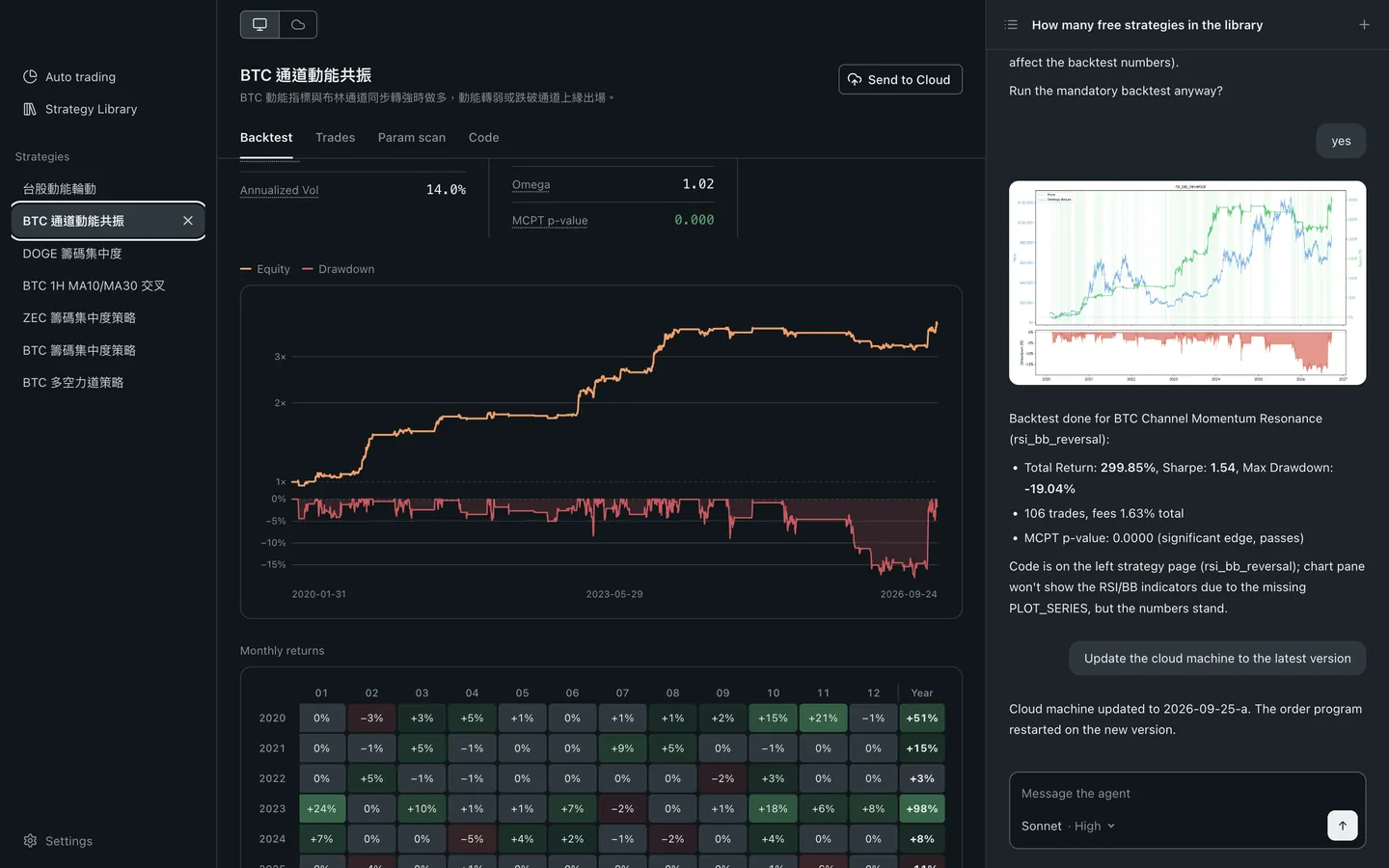
Here is a real example from Blave Agent's own backtest engine — btc_sma_cross on BTCUSDT 1h, SMA45/SMA100, running from 2022-01-01 to whatever day the backtest is run (the figures below are a snapshot of one such run, made when the example's fee was 0.05% per side). Total return was more than double buy-and-hold. It also had a −42.6% maximum drawdown, and over those four years fees cumulatively ate about 22% of equity.
All three numbers matter, and only the first one is the one people quote. A strategy that doubles buy-and-hold while asking you to sit through a 42% drawdown is not obviously better than one that returns less and never scares you out. And fees adding up to about 22% of equity mean the trading frequency is not free — a faster version of the same idea can hand its entire edge to the exchange.
The workflow that produces those numbers is always the same five steps:
Write the idea as explicit rules.
Backtest it over a period that includes at least one real drawdown.
Check whether the result survives changing the parameters slightly — this is where most ideas quietly die.
Blave Agent splits "having the idea" from "building the infrastructure". You describe the strategy in conversation, and the agent researches it, writes the code, runs the backtest, and takes it live. Two ways to run it: the free, open-source desktop app with your own Claude Code or Codex, or the same workspace on your own cloud machine, which keeps going with your computer off and is reachable from the web, Telegram or SSH.
Data. Market data comes from Blave's own API — crypto, Taiwan equities and futures — so you are not separately licensing feeds and maintaining ingestion for each one.
Execution. Which venues are officially supported, how the order libraries are verified on real accounts before they ship, and which interfaces you can hand a strategy to the agent through — see What Is Algorithmic Trading?
If you do not have an idea yet, the official strategies are free and every one ships with its real backtest. A strategy sent for verification has to clear three gates — an honest backtest, a Monte Carlo permutation test for statistical significance, and a parameter-robustness check — and only one that clears all three carries the Verified badge. No badge means at least one gate failed, or the gates have not been run yet — the strategy's detail page shows where each gate stands.
How do you know you're not fooling yourself?
Five checks. If a strategy fails any of them, the backtest number is not telling you what you think it is.
1
Can you write the rule as one sentence? "When X is true, do Y, and exit when Z." If you cannot, you have an instinct, not a strategy — and there is nothing to test yet.
2
Does the backtest window contain a real decline? A strategy that has only ever been tested through a bull market has not been tested. Look for the worst period in your asset's history and make sure it is inside the window.
3
Are fees in the backtest? The btc_sma_cross snapshot above, at 0.05% per side, had fees cumulatively eat about 22% of equity over four years. The example now uses the crypto-perp default of 0.1% per side (slippage included, deliberately conservative): from 2022-01-01 to 2026-10-22 fees cumulatively ate about 48.7% of equity, for a total return of +79.5% — about the same as buy-and-hold's +78.5%. Match the rate to the market you trade. The fee gate for listing an official strategy checks exactly this — FEE has to be ≥ that venue's VIP0 taker rate, and understating it does not pass.
4
How many parameter combinations did you try? Scan a hundred and a few will look significant on luck alone. If you tuned the parameters on all your data and then reported the result on that same data, you are reporting training error.
5
Could you sit through the worst drawdown in the report? −42.6% on a $1M account is a $426,000 paper loss. If that would make you switch the strategy off, size down until it would not — the drawdown you cannot hold is the one that turns a paper loss into a real one.
What quant trading will not do for you
It will not find the edge. Backtesting validates an idea you already had; it does not generate one, and a systematic process wrapped around a rule with no edge just loses money more consistently.
It will not make the past a promise. A backtest is a measurement of what already happened under conditions that may not repeat. Market structure changes, and rules built for the old structure keep running anyway.
And it will not remove the human decision. You still choose which drawdown you can live with and how much capital to commit. Those choices sit outside the model, and they decide more outcomes than the model does.
Starting without an idea
You do not have to arrive with a perfect strategy. Deploy an official one, watch how it behaves through a losing week, and modify it into your own version once you understand what its numbers are telling you.
Downloading. When you open the installer, Windows first shows “Windows protected your PC”:
Click “More info”.
Click “Run anyway”. Blave installs and opens on its own.
The first launch sets up its runtime and takes a few minutes.
Windows warns because the installer isn't code-signed yet (we've applied for a certificate), so it can't identify the publisher. The source is public on GitHub. See the full steps