OKX Fees Explained: What Auto Trading Costs You in a Year
Use the official rates and a real backtested strategy to see how far maker and taker fees differ, then how to pay less.
No OKX account yet? Sign up for OKX
- OKX futures fees for regular users: 0.02% maker, 0.05% taker. Spot is 0.08% and 0.10%.
- One strategy made 385 trades over 5.5 years. All taker fills cost 19.25% of capital; all maker fills, only 7.7%.
- Three ways to pay less in auto trading: rest limit orders and wait for fills, trade less often, and move up a VIP tier.
- Count fees in the backtest. What's left after costs is the real profit.
What are OKX's fees?
An OKX fee is a percentage of the trade value charged on every fill. Futures are cheaper than spot, and maker fills are cheaper than taker fills.
OKX official fee rates (OKX fee page, checked 2026-11-18):
| Type | Maker | Taker | Tier requirement |
|---|---|---|---|
| Spot, regular user | 0.080% | 0.100% | Assets < $100,000 and 30-day volume < $1,000,000 |
| Futures, regular user | 0.020% | 0.050% | Assets < $100,000 and 30-day volume < $5,000,000 |
| Futures, VIP 1 | 0.016% | 0.045% | Assets ≥ $100,000 or 30-day volume ≥ $5,000,000 |
Example: a 10,000 USDT market order on futures pays 10,000 × 0.05% = 5 USDT in fees.
To trade at these rates, sign up for OKX now and connect it once the backtest and paper trading hold up.
What's the difference between maker and taker?
A maker order is a limit order that rests on the order book until someone trades against it. It adds liquidity, so the fee is lower. A taker order trades against an order already on the book, and a market order is always a taker.
A limit order isn't always a maker order. A buy priced at or above the best ask fills the moment it arrives and is charged as a taker.
How much does auto trading pay in a year?
Auto trading enters and exits more often than manual trading, so fees add up. At the regular-user futures rate, a strategy that trades 4 times a week makes about 208 round trips a year:
- All market orders: 0.10% per round trip, 20.8% of the position a year
- All maker orders: 0.04% per round trip, 8.32% of the position a year
The gap is more than 12 percentage points, which the strategy has to earn on top just to break even.
A real strategy as an example
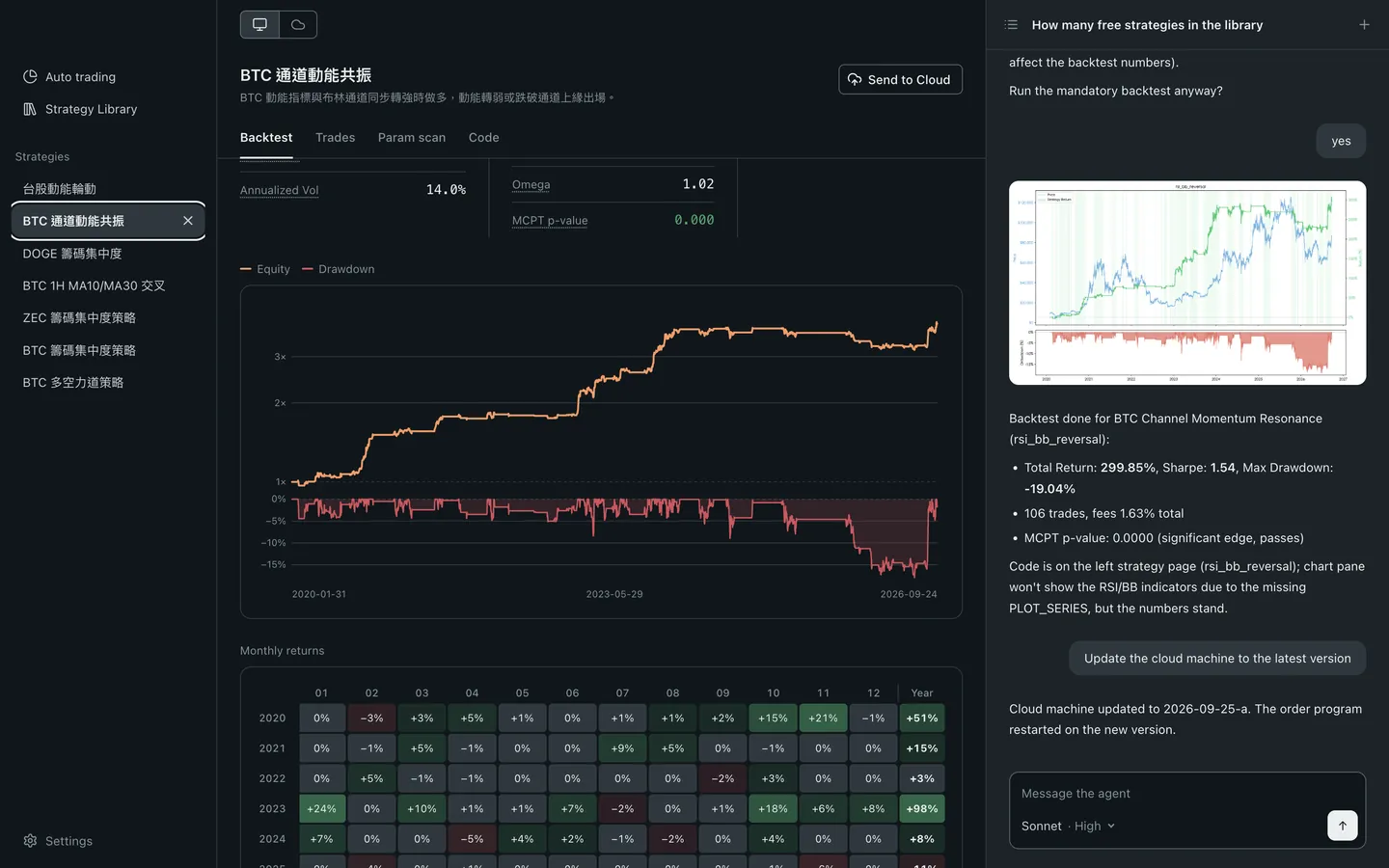
We backtested a BTC perpetual holder concentration strategy with Blave Agent: 2021-05-11 to 2026-11-18, daily bars, long only. It made 385 trades in total (each counted as one one-way fill) and returned +207%.
The same 385 trades at different rates, with total fees as a share of capital:
| Fee per side | Scenario | Total fees |
|---|---|---|
| 0.02% | Every fill as maker | 7.70% |
| 0.05% | Every fill as taker (the rate used in the actual backtest) | 19.25% |
| 0.10% | Blave backtest default, a conservative estimate that includes slippage | 38.50% |
The 0.05% row is the figure the agent reported from the real backtest. The other two rows apply a different rate to the same number of trades. On fees alone, taker costs 2.5 times maker. With slippage counted, the conservative estimate is 5 times the all-maker cost.

Backtest your own strategy with Blave Agent
How can auto trading pay less in fees?
- Rest limit orders and wait for fills. In Blave Agent, Auto Trading › Settings › Execution offers Chase limit. It places a post-only limit order at the best price on your own side, cancels and re-places it when the book moves, and fills whatever is left after 45 seconds at market. Most of the fill is charged the maker rate, and only the part it can't catch is taker.
- Trade less often. Ask the agent to add a filter in the backtest, for example entering only after the signal holds for two days in a row. Half as many trades means half the fees. Then check whether returns dropped with them.
- Move up a VIP tier. With $100,000 in assets or $5,000,000 in 30-day futures volume you reach VIP 1, and taker drops from 0.05% to 0.045%. For most retail traders, the first two save more.
Count fees in the backtest first
Blave Agent backtests charge fees on every position change. For crypto perps the default is 0.1% per side, higher than the OKX taker rate because it also covers slippage. To see your actual cost, tell the agent your rate, for example "use the OKX taker fee of 0.05%".
If a strategy looks great but trades a lot, run it again at 0.1%. Only if it still holds up after that is it worth connecting a real account.
Sign Up for OKXFor the full path to going live, see OKX Auto Trading: From Idea to Backtest to Live.
FAQ
Which is cheaper on OKX, spot or futures?
Futures. For regular users the futures taker fee is 0.05% and the spot taker fee is 0.10%, twice as much.
Is the funding rate a fee?
No. Funding is paid between longs and shorts on perpetual futures at regular intervals (currently every 8 hours on most major contracts such as BTC and ETH), not to the exchange. See OKX Funding Rates.
Is Chase limit always cheaper?
Most of the time, but not always. In a fast market, whatever it can't fill within 45 seconds goes to market and is charged as taker.
Isn't the 0.1% backtest default too high?
It's conservative on purpose. Real fills often slip, especially market orders and small coins. A strategy that still makes money at 0.1% usually does better at your real rate.
Risks first
Lower fees don't make a strategy profitable. A backtest uses past data, and live fills also meet slippage and changing markets. Leverage magnifies losses too. Paper trade for a while before you decide whether to put in real money, and how much.